ACCESS
Ramps & level changes
Evaluating elevation change, available run, approach, turning space, landing needs and how the patient will actually use the entrance.

MICHIGAN AUTO NO-FAULT HOME MODIFICATION EVALUATIONS
Occupational Therapy-led Home Modification Evaluations for people with catastrophic Motor Vehicle Crash injuries — focused on accessibility, safety, transfers, mobility, caregiver needs and long-term independence.
CLINICAL FUNCTION BEFORE CONSTRUCTION
The first question is not “What can we build?” It is: What does this patient need to function safely and as independently as reasonably possible in this home?
A serious injury can transform an ordinary home into a series of barriers. The front entrance may no longer be usable. A bathroom may not allow safe transfers. Hallways may not accommodate mobility equipment. The bedroom may not provide enough space for caregivers or equipment.
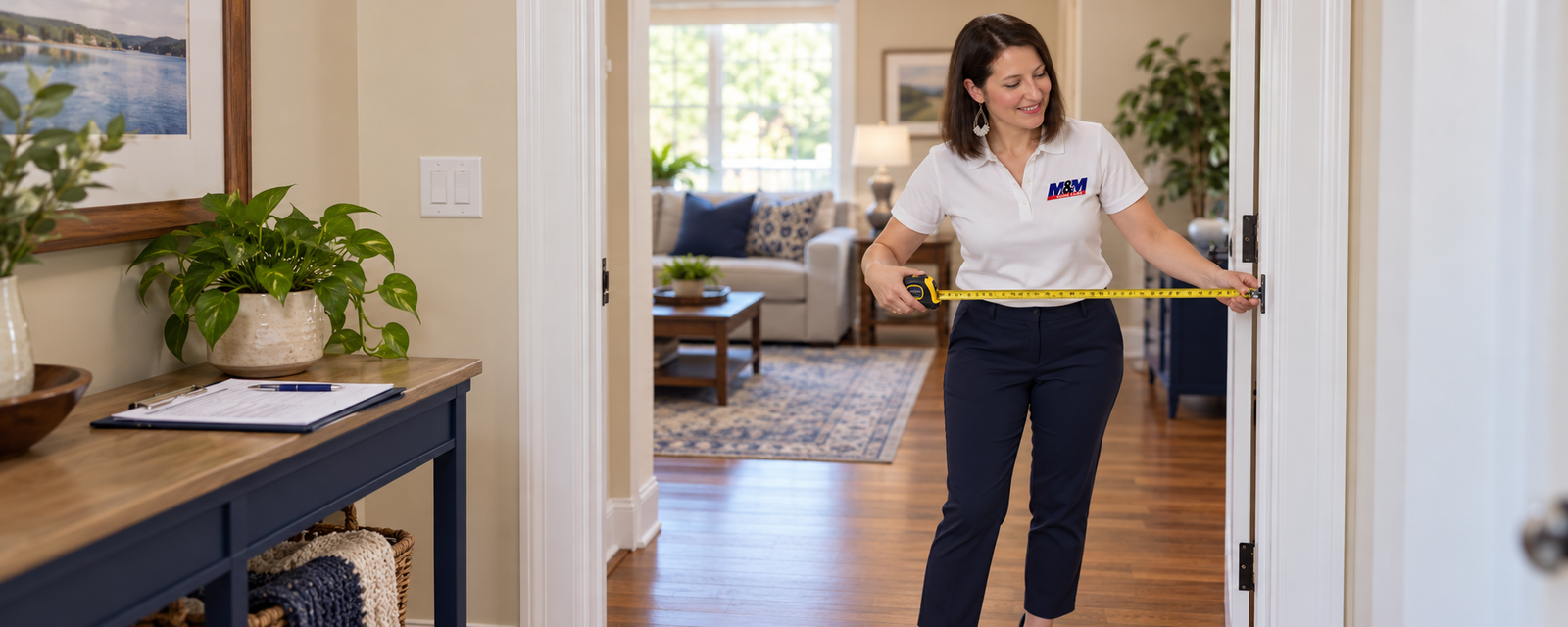
M & M Home Care approaches Home Modification Evaluations through Occupational Therapy, functional assessment and direct observation of the person interacting with the environment.
ADVANCED HOME MODIFICATION EXPERTISE
Christine brings advanced expertise in Occupational Therapy, brain injury, aging-in-place principles, functional assessment, attendant care evaluation and home modification.
Home modification after catastrophic injury requires more than knowledge of ramps and grab bars. The evaluator must understand the person’s diagnosis, mobility, transfers, cognition, vision, endurance, wheelchair use, caregiver requirements, equipment and likely long-term functional needs.
That is why M & M Home Care treats Home Modification Evaluation as an advanced Occupational Therapy service rather than a construction consultation.
ENTERING & EXITING THE HOME
Entrance recommendations must account for the patient, the mobility device, the grade, the available space, weather exposure, caregiver assistance and emergency egress.
Evaluating elevation change, available run, approach, turning space, landing needs and how the patient will actually use the entrance.
Door width, thresholds, opening direction, hardware and whether the patient can approach and pass through with equipment.
Considering how the patient and caregivers can exit the home safely during emergencies and changing conditions.
BATHROOM ACCESSIBILITY
Bathing, toileting, transfers, wet surfaces, limited maneuvering room and caregiver assistance all converge in a relatively small space.
A bathroom recommendation should reflect how this patient actually transfers, bathes, toilets and receives assistance — not a generic accessibility checklist.
BEDROOM & PERSONAL CARE
The bedroom may need to accommodate a hospital bed, wheelchair, lift, bedside equipment, caregiver access and transfers from more than one side of the bed.
The evaluation considers whether the current room supports safe sleeping, dressing, transfers, nighttime care and emergency access.
KITCHEN & DAILY LIVING
A home is functional only if the patient can use the spaces needed for daily life.
WHEELCHAIR ACCESS
Width, turning radius, seat height, footplate position, transfer style and caregiver assistance all affect how much space is truly needed.
Can the patient pass through doors and hallways without unsafe contact, repeated repositioning or caregiver strain?
Is there enough room to turn, approach fixtures, position for transfers and use equipment safely?
The evaluation focuses on how the wheelchair is actually used in the patient’s home — not just theoretical dimensions.
TRANSFERS & CAREGIVER ACCESS
A patient may transfer independently, require cueing, need one-person assistance, need two-person assistance or use mechanical equipment. The physical space has to support the actual transfer method.
Caregiver access matters too. A room that technically fits the patient may still be unsafe if there is no room for the caregiver to assist without twisting, reaching or working in a compromised position.
EQUIPMENT & ASSISTIVE TECHNOLOGY
TBI & COGNITIVE SAFETY
A patient may be able to physically move through the home and still be unsafe because of impaired memory, judgment, initiation, sequencing, impulsivity or poor awareness.
Home modification after traumatic brain injury may involve environmental structure, visual cues, simplified access, hazard reduction and other strategies designed around the patient’s cognitive limitations.
The goal is not to create a sterile environment. The goal is to reduce preventable risk while supporting as much independence as the patient can safely manage.
A person can be physically independent and still require environmental modification because of cognitive impairment.
SCI & CATASTROPHIC INJURY
Spinal cord injury and other severe mobility impairments may require major changes in access, transfers, caregiver space, equipment and long-term use of the home.
CURRENT NEEDS & LONG-TERM PLANNING
A patient’s abilities may change after hospitalization, inpatient rehabilitation, surgery or ongoing therapy. Some needs may improve. Others may become permanent. Equipment may also change.
A thoughtful evaluation distinguishes immediate barriers from likely long-term needs so recommendations are not based solely on a snapshot in time.
Recommendations should be based on documented clinical information, current performance and reasonably anticipated needs — without pretending to know exactly how the patient will function years from now.
CLINICAL INDEPENDENCE
The recommendation should answer a clinical question: Why does this patient need this change because of the injury and resulting functional limitation?
More expensive does not automatically mean more appropriate. The purpose of the evaluation is to identify the clinically justified solution — not to maximize the size or cost of a construction project.
DOCUMENTATION
A useful report should allow the reader to understand what the patient cannot safely do, what part of the environment is creating the barrier, and why the recommended change is clinically appropriate.
CLEAR BOUNDARIES
Evaluate function, identify environmental barriers and make clinically justified recommendations within the Occupational Therapy scope.
Develop construction plans, specifications, code compliance details, pricing and the actual building solution.
M & M Home Care does not determine insurance coverage, legal entitlement, funding approval or reimbursement.
MICHIGAN AUTO NO-FAULT
Serious Motor Vehicle Crash injuries often involve long-duration rehabilitation, multiple providers, equipment, attendant care, accessibility needs and substantial documentation.
M & M Home Care has extensive experience treating people injured in Motor Vehicle Crashes and working within the Michigan Auto No-Fault environment.
Our Home Modification recommendations remain grounded in clinical function, medical necessity, safety and the patient’s actual environment.
M & M Home Care does not provide legal advice, determine coverage or decide entitlement to benefits.
Funding, authorization, reimbursement and legal interpretation are separate from the clinical evaluation itself.
MULTIDISCIPLINARY REHABILITATION
WHEN TO REFER
HOME MODIFICATION REFERRALS
Call 248.599.2410 or use the referral process and identify Home Modification Evaluation as the requested service.
We discuss the injury, location, living situation, current barriers, equipment and reason the evaluation is being requested.
Orders, records, demographics, claim information, authorizations and other required materials are identified.
The evaluator considers functional abilities, transfers, mobility, equipment, caregiver needs and environmental barriers in the actual home.
Recommendations are based on the clinical findings and the relationship between the patient’s function and the home environment.
The report documents the barriers identified, the functional rationale and the recommendations developed from the evaluation.
WHY M & M HOME CARE
It is an Occupational Therapy-led clinical evaluation of how a serious injury affects the person’s ability to function within the home.
Talk with M & M Home Care about Occupational Therapy-led Home Modification Evaluations for accessibility, transfers, wheelchair use, caregiver needs, safety and long-term function after a serious Motor Vehicle Crash.