Identity
“Who am I now?”
A serious injury can change work, independence, mobility, relationships, privacy and everyday capability. Counseling can help the patient explore those changes without reducing the person to the injury.

MICHIGAN AUTO NO-FAULT COUNSELING
Counseling for the emotional, psychological and relational consequences of serious Motor Vehicle Crash injuries — helping patients adjust, cope, reconnect with meaningful roles and participate more fully in rehabilitation.
THE PSYCHOLOGICAL SIDE OF REHABILITATION
Counseling creates space to address those changes directly — not as an afterthought to physical rehabilitation.
After a catastrophic Motor Vehicle Crash, patients may be coping with pain, disability, dependence on others, inability to work, changes in family roles, uncertainty about recovery, financial pressure, fear of reinjury, grief over lost abilities and the emotional burden of a prolonged medical process.
Counseling can help patients understand and respond to those changes while developing practical coping strategies that support day-to-day function and rehabilitation participation.
ADJUSTMENT TO CATASTROPHIC INJURY
For patients with TBI, SCI or other serious injuries, counseling may help address the gap between who the person was before the crash and how life now looks.
A serious injury can change work, independence, mobility, relationships, privacy and everyday capability. Counseling can help the patient explore those changes without reducing the person to the injury.
Patients may grieve abilities, routines, roles, plans, freedom and the life they expected to have — while still being asked to work toward recovery. That grief deserves clinical attention.
Adaptation is not giving up. It is learning how to live effectively with what has changed while continuing to pursue meaningful goals, relationships, participation and as much independence as possible.
ANXIETY & TRAUMA-RELATED STRESS
Some patients experience persistent fear, distress, intrusive memories, avoidance or heightened alertness after a serious Motor Vehicle Crash.
Counseling can help patients develop strategies for managing distress and re-engaging with necessary activities at a pace that is clinically appropriate.
MOOD & MOTIVATION
Loss of work, mobility, social activity, driving, intimacy, financial independence and ordinary routines can leave patients feeling isolated or disconnected from the life they once knew.
Counseling may help patients identify patterns of withdrawal, rebuild structure, reconnect with meaningful activity and develop practical ways to move forward.
Low motivation, hopelessness, anxiety or emotional exhaustion may interfere with treatment attendance, home exercise, communication, self-care and willingness to attempt difficult tasks.
CHRONIC PAIN & EMOTIONAL HEALTH
Chronic pain can affect sleep, concentration, activity, relationships, mood, confidence and a patient’s willingness to move.
TBI & EMOTIONAL CHANGE
After TBI, emotional and behavioral changes may overlap with cognitive impairment, fatigue, frustration, loss of insight and changes in impulse control.
Patients may struggle with irritability, frustration tolerance or emotional lability after brain injury.
Reduced awareness of deficits may complicate adjustment, relationships, safety and treatment participation.
Spouses, parents and caregivers may be adapting to changes in personality, independence, supervision needs and communication.
Counseling for a person with TBI should be coordinated with the broader rehabilitation team when cognitive impairment meaningfully affects participation, communication or safety.
SCI & LOSS OF INDEPENDENCE
Spinal cord injury can affect mobility, self-care, intimacy, employment, parenting, community access and the ability to make ordinary decisions without assistance.
Counseling may help patients process these changes while developing coping strategies and identifying meaningful ways to preserve autonomy and participation.
FAMILY & CAREGIVER STRAIN
Partners, parents, children and caregivers may all be adapting to new responsibilities, uncertainty and changes in the family system.
RETURN TO WORK & COMMUNITY LIFE
A patient returning to work, driving, school, recreation or community activity may be confronting fear, reduced confidence, cognitive changes, fatigue, physical limitations and concern about how others will respond.
Counseling may support the emotional side of reintegration while other disciplines address the physical and cognitive demands.
COPING & EMOTIONAL REGULATION
Counseling can help patients develop practical strategies for managing stress, emotions, uncertainty and the repeated demands of rehabilitation.
COUNSELING INSIDE THE REHABILITATION PLAN
Mood, anxiety, trauma-related stress and coping can influence how a patient participates in therapy, communicates with caregivers and adapts to disability.
ACCESS TO COUNSELING
Serious injury may make transportation difficult because of mobility limitations, fatigue, attendant care needs, pain, rural location or the practical burden of adding another trip to an already demanding medical schedule.
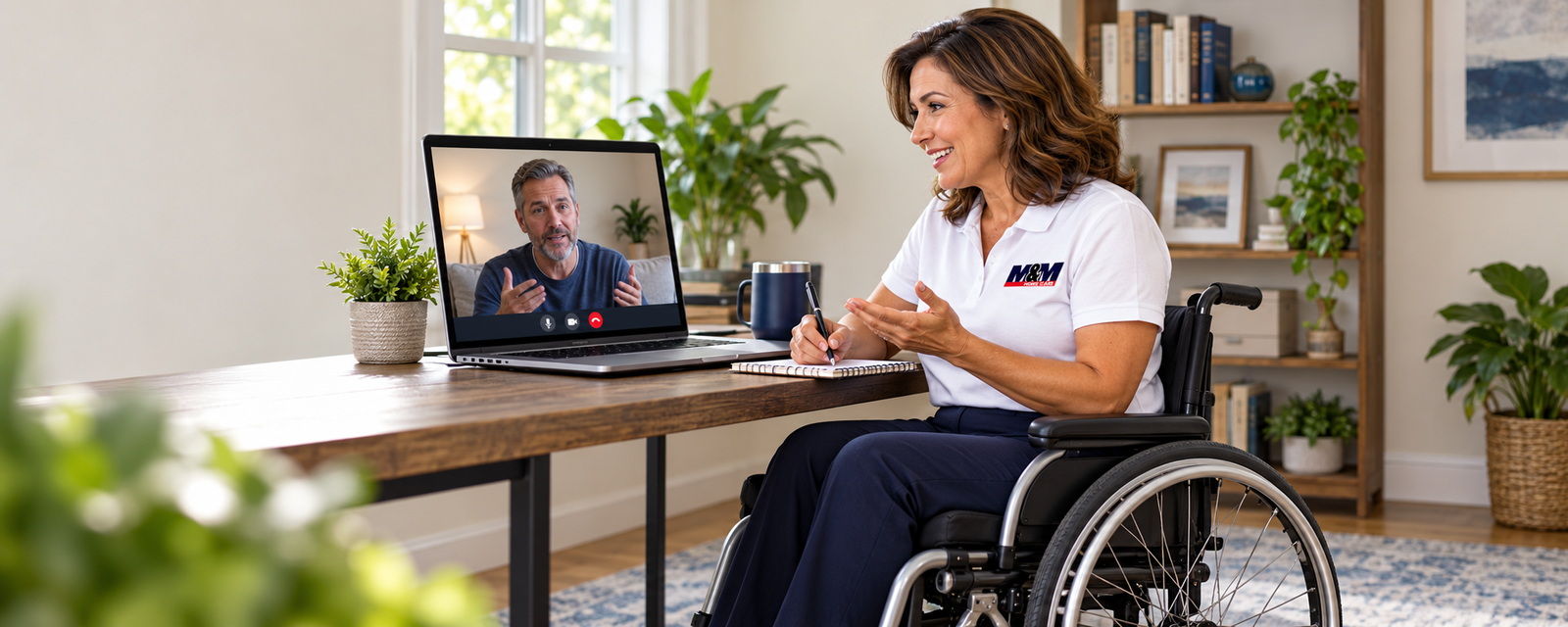
When clinically appropriate and available, telehealth can reduce those barriers while allowing the patient to receive counseling from home.
Flexible delivery can be particularly valuable for patients whose injuries make travel difficult or exhausting.
POTENTIAL BENEFITS
No outcome should be guaranteed. The value of counseling is in helping the patient build healthier ways to respond to the emotional demands of injury and rehabilitation.
DOCUMENTATION & CLINICAL BOUNDARIES
M & M Home Care’s role is clinical. Counseling addresses the patient’s emotional and psychological needs within the provider’s professional scope.
Symptoms, stressors, functional impact, treatment goals, interventions, response and progress.
Relationships, rehabilitation participation, work, community activity, coping, sleep, motivation and role function.
Counseling is not provided to manufacture a legal narrative, determine coverage or decide entitlement to benefits.
MICHIGAN AUTO NO-FAULT
Serious Motor Vehicle Crash injuries often involve prolonged rehabilitation, multiple providers, chronic pain, disability, work disruption, family strain, litigation stress and uncertainty about the future.
M & M Home Care has extensive experience treating people injured in Motor Vehicle Crashes and working within the Michigan Auto No-Fault environment.
Our role remains clinical. Counseling recommendations should be based on the patient’s presentation, treatment needs and response to care.
M & M Home Care does not provide legal advice, determine insurance coverage or decide entitlement to benefits.
COUNSELING EXPERTISE
M & M Home Care’s published team information identifies Katlin Dunford, LPC, as a Counseling provider. Counseling availability and provider assignment are assessed for each referral.
The value of Counseling at M & M Home Care is not simply access to a therapist. It is access to counseling within a broader rehabilitation organization that understands serious Motor Vehicle Crash injuries, TBI, SCI, chronic pain, loss of function and the realities of Michigan Auto No-Fault.
That context matters because the emotional challenges of catastrophic injury are often inseparable from physical disability, cognitive change, caregiver dependence and long-term rehabilitation.
E-E-A-T should be visible. The page should identify the licensed discipline, the clinical context and the actual types of injury-related problems being addressed rather than relying on generic statements about “emotional support.”
WHO WE HELP
Adjustment, emotional regulation, family strain, identity change, frustration, cognitive-related stress and community reintegration.
Loss of independence, caregiver dependence, body-image concerns, role changes, relationship adjustment and long-term adaptation.
Persistent pain, uncertainty, work disruption, grief, reduced independence, prolonged recovery and the emotional impact of living with lasting limitations.
WHEN TO REFER
COUNSELING REFERRALS
Call 248.599.2410 or use the referral process and identify Counseling as the requested service.
We discuss the injury, patient location, current concerns, relevant diagnoses and the reason Counseling is being requested.
Orders, records, demographics, claim information, authorizations and other required materials are identified when applicable.
The referral is assessed for appropriateness, provider availability and the most practical treatment format.
The counselor develops goals based on the patient’s current emotional, functional and rehabilitation needs.
The record reflects the clinical issues addressed, treatment goals, response to care and relevant progress over time.
WHY M & M HOME CARE
The emotional consequences of catastrophic injury deserve the same clinical seriousness as the physical ones.
Talk with M & M Home Care about Counseling for adjustment, trauma-related stress, anxiety, depression, chronic pain, family strain, loss of independence and the emotional challenges that can follow a serious Motor Vehicle Crash.